
Professor Zhang, the head of a chemistry lab at a university, recently purchased a fully automatic bottle washer for the lab. The machine cleans thoroughly and works efficiently, and the team is very satisfied with it. However, after two weeks of use, a problem arose: although the washed glassware was clean and clear, it still needed to be processed in a separate autoclave for microbiological experiments; the sterilized bottles were piled on the lab bench, and by the next day, they were covered in a layer of dust.
It was only then that Professor Zhang realized the bottle washer is just the first step; there are still two more hurdles to clear: sterilization and storage.
This scenario is far from unique. Many labs source dishwashers, sterilizers, and disinfection cabinets from different suppliers during procurement, often resulting in awkward situations where “the dishes are clean but the sterilization equipment isn’t compatible, or the disinfection cabinet is too small.” In reality, these three pieces of equipment form a complete “wash-sterilize-disinfect” workflow, and when properly coordinated, they can significantly improve laboratory operational efficiency.
The Roles of Bottle Washers, Sterilizers, and Disinfection Cabinets
Bottle washers address the issue of “how thoroughly items are cleaned,” sterilizers address the issue of “whether bacteria are present,” and disinfection cabinets address the issue of “whether storage is safe.” Each serves a distinct purpose and cannot be substituted for the others.
| Equipment | Core Function | Primary Problem Solved | Key Notes |
|---|---|---|---|
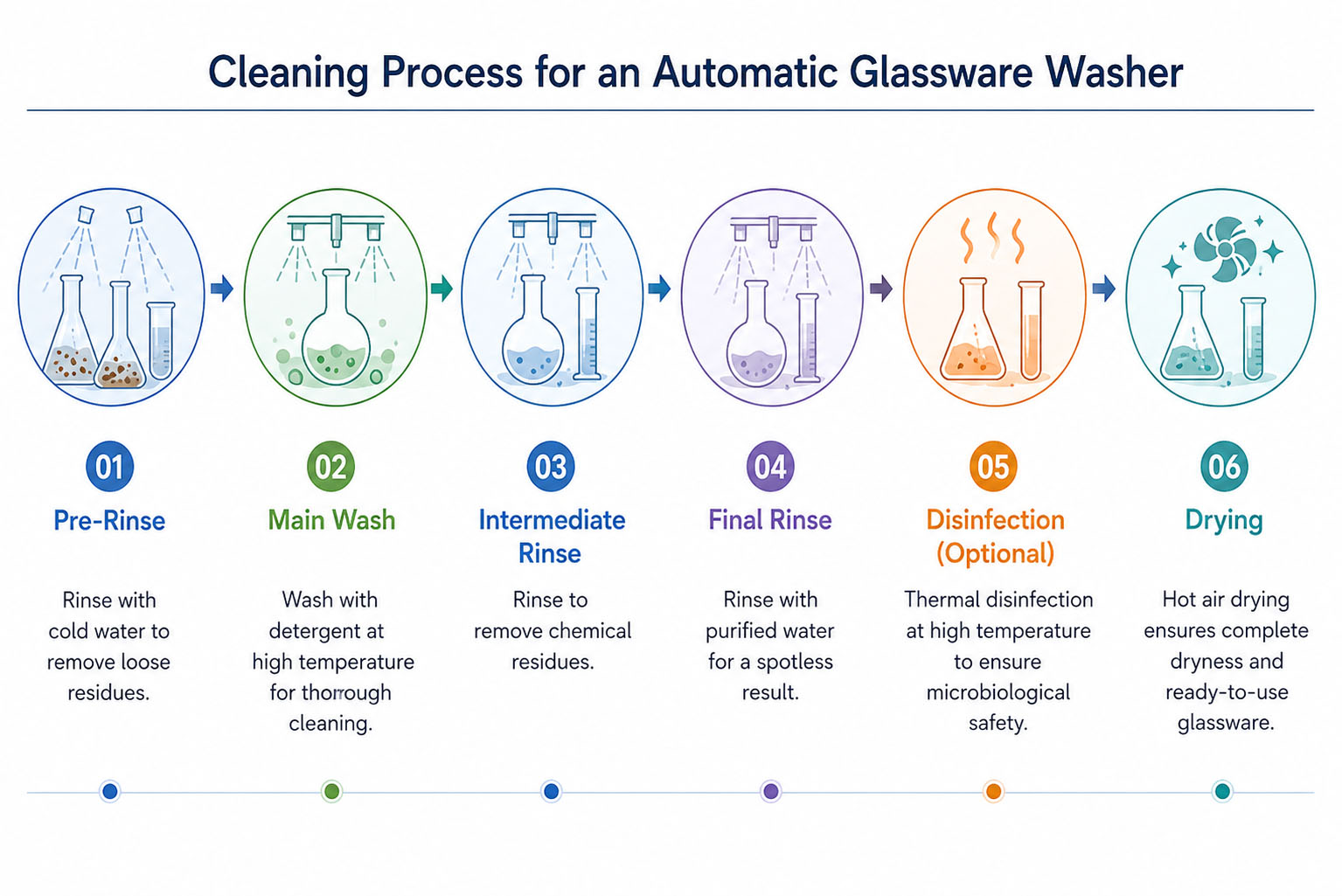
| Glassware Washer | Automatically cleans laboratory glassware through pre-wash, main wash, rinsing, and drying programs. | Eliminates inefficient manual cleaning, improves cleaning consistency, and reduces exposure to hazardous chemicals. | Some models include a drying function, but drying does not equal sterilization. |
| Autoclave (Sterilizer) | Uses saturated steam under high temperature and pressure (typically 121°C or 134°C) to destroy microorganisms. | Eliminates bacterial spores, fungi, viruses, and other microorganisms to achieve sterility. | A standalone device that must be purchased separately; classified as a pressure vessel. |
| Disinfection Cabinet | Uses UV light, ozone, or low-temperature heated air for routine disinfection and clean storage of instruments and glassware. | Prevents secondary contamination of sterilized items during storage. | A standalone device that must be purchased separately and can maintain a clean storage environment for extended periods. |
There is a common misconception that warrants clarification: a dishwasher with a drying function does not equate to sterilization. The temperature during the drying phase typically ranges from 80°C to 120°C, and its primary purpose is to remove moisture from the surface of the containers; this temperature is insufficient to kill bacterial spores. To achieve true sterilization, saturated steam at 121°C or higher must be maintained for a specific duration. Therefore, the misconception that “if a bottle washer has washed and dried the bottles, they are sterile” needs to be corrected.
Typical “Washing and Sterilization Line” Configuration Options
Since laboratories vary in size and requirements, their configurations should also differ accordingly. Below are three typical configuration approaches based on laboratory type and average daily throughput.
Solution 1: Entry-Level Model
Intended for: Small laboratories, university teaching laboratories, and facilities with a daily bottle-washing volume of 100 or fewer
| Process Stage | Equipment Type | Key Specifications (Reference) |
|---|---|---|
| Cleaning | Basic Glassware Washer (without drying or with basic drying function) | Chamber capacity: approximately 120–190 L; circulation pump flow rate: 300–500 L/min; 304 stainless steel exterior with 316L stainless steel chamber |
| Sterilization | Portable or Small Vertical Autoclave | Capacity: 30–50 L; maximum operating temperature: 135°C; equipped with safety interlock system |
| Disinfection & Storage | Benchtop or Small Vertical Disinfection Cabinet | Capacity: 50–80 L; combined UV and ozone disinfection technology for effective decontamination and clean storage |
Workflow: Washing in a bottle washer → Air drying or oven-assisted drying → Sterilization in a sterilizer → Storage in a disinfection cabinet
Solution Features: Low initial investment, suitable for laboratories with limited budgets or compact spaces. A bottle washer model without a drying function can be selected; after washing, the glassware is dried using the laboratory’s existing oven before proceeding to the sterilization stage.
Solution 2: Standard High-Efficiency Model
Target Audience: Corporate QC laboratories and third-party testing laboratories, with a daily bottle washing volume of 100–300 bottles
| Process Stage | Equipment Type | Key Specifications (Reference) |
|---|---|---|
| Cleaning | Mid-Range Glassware Washer (with Drying Function) | Chamber capacity: approximately 190–280 L; circulation pump flow rate: 400–500 L/min; equipped with a HEPA high-efficiency filtered drying system; supports multiple customizable washing programs |
| Sterilization | Vertical Autoclave (with Drying Function) | Capacity: 50–100 L; supports multiple sterilization programs; optional built-in printer for sterilization parameter recording and traceability |
| Disinfection & Storage | Vertical Disinfection Cabinet | Capacity: 100–150 L; combines UV sterilization, ozone disinfection, and medium-temperature drying; supports programmable timed disinfection cycles |
Workflow: Bottle washer (wash + dry) → Sterilizer (including drying) → Storage in a disinfection cabinet
Solution Features: With the bottle washer’s drying function, containers are dry upon removal and can be sent directly to the sterilizer, eliminating the need for intermediate air-drying and significantly improving efficiency. It is recommended to equip the sterilizer with data logging capabilities to facilitate laboratory quality traceability.
Solution 3: High-End Fully Automatic Model
Suitable for: Pharmaceutical GMP laboratories, biosafety laboratories, and facilities with a daily bottle washing volume of 300 or more
| Process Stage | Equipment Type | Key Specifications (Reference) |
|---|---|---|
| Cleaning | High-End Glassware Washer (Large Capacity, Advanced Drying & Intelligent Control) | Chamber capacity: 280 L and above; circulation pump flow rate: 500–800 L/min; PLC or microprocessor-based control system; supports multi-level user access management and audit trail functionality for data traceability |
| Sterilization | Large Vertical or Horizontal Autoclave | Capacity: 100 L and above; supports pre-vacuum/pulsating vacuum sterilization cycles; equipped with printer and data communication interfaces; suitable for IQ/OQ/PQ (3Q) validation |
| Disinfection & Storage | Large-Capacity Disinfection Cabinet or Clean Storage Cabinet | Capacity: 150 L and above; features multiple disinfection modes (e.g., UV, ozone, heated air); provides clean environment maintenance for long-term sterile storage |
Workflow: Bottle washer (washing + drying) → Sterilization in a sterilizer (with data logging and validation) → Clean storage in a disinfection cabinet
Solution Features: High degree of automation throughout the entire process; each piece of equipment is equipped with data traceability capabilities. Meets compliance requirements for cleaning and sterilization processes as stipulated by GMP, GLP, and other regulations. Suitable for laboratories with strict sterility requirements.
How to Choose When Purchasing
Should You Choose a Bottle Washer with a Drying Function?
This is one of the most common questions when selecting a model. Bottle washers with a drying function use hot air filtered through a HEPA filter to dry the glassware after the wash cycle is complete. The glassware can be removed and used immediately or moved on to the next step. Models without a drying function require manual transfer of the glassware to an oven or air-drying.
Recommendation: If your laboratory has a high daily volume of glassware to wash, requires efficient workflow, or has limited space that makes it difficult to accommodate an additional oven, we recommend choosing a model with a drying function. If your budget is limited, you already have an oven, and the glassware can be processed in batches, a basic model without a drying function will fully meet your needs.
What capacity should the autoclave be?
The choice of autoclave capacity primarily depends on the quantity and types of vessels requiring sterilization in a single cycle.
Autoclaves ranging from 30L to 50L are suitable for small-batch sterilization, such as culture media and a small amount of glassware. These are commonly found in teaching laboratories or small R&D labs. The 50L to 100L range is the most commonly used size for laboratories. It can meet the vast majority of daily sterilization needs. Large sterilizers with capacities of 100L or more are suitable for batch processing or scenarios requiring simultaneous handling of laboratory waste.
Additionally, the functional configuration of the sterilizer is worth considering: a basic manual control model can meet routine needs; smart models with preset programs, automatic venting, and drying functions offer more convenient operation; for laboratories requiring data traceability, it is recommended to opt for models with printing or data logging capabilities.
Is a sterilization cabinet a necessity or an optional item?
The role of sterilization cabinets in laboratories is often underestimated. If sterilized instruments are directly exposed to the laboratory environment, they may become recontaminated with airborne microorganisms within a few hours. The purpose of a sterilization cabinet is to provide a continuously clean storage environment following sterilization.
Recommendation: For sterile rooms, clean zones, or laboratories with high requirements for experimental precision, a sterilization cabinet is strongly recommended. For general physical and chemical laboratories, if sterilized glassware is used up on the same day, a sterilization cabinet may not be considered essential; however, it is recommended to reserve space for future installation.
Clarifying Common Misconceptions
| Common Misconception | Correct Understanding |
|---|---|
| A glassware washer with a drying function is equivalent to sterilization. | Drying temperatures are typically 80–120°C, which are insufficient to destroy bacterial spores. Sterilization requires saturated steam at 121°C or higher maintained for a specified period. |
| An autoclave can be used as a long-term disinfection or storage cabinet. | An autoclave is designed for intermittent sterilization cycles. Sterilized items should be removed after the cycle is complete. It is not intended for long-term storage. A disinfection cabinet is designed to maintain a continuously clean environment. |
| A disinfection cabinet can replace an autoclave. | Disinfection cabinets typically target vegetative bacteria and routine microbial contamination, whereas autoclaves can eliminate all microorganisms, including bacterial spores. The two devices provide different levels of microbial control and are not interchangeable. |
| All three devices must be purchased from the same manufacturer. | Purchasing from the same brand is not mandatory. However, sourcing equipment from a single supplier can simplify after-sales service, maintenance, training, and system compatibility management. |
Conclusion
When it comes to purchasing laboratory equipment, the goal is not simply to acquire individual machines but to build a highly efficient workflow. Bottle washers, sterilizers, and disinfection cabinets are three closely interconnected components of this workflow. Shifting from “point-by-point procurement” to “systematic planning” not only enables better coordination among the equipment but also ensures that every dollar invested in the laboratory delivers maximum value.
Get Social