
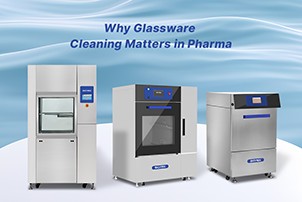
A glassware washer is a core piece of equipment for cleaning laboratory glassware. It uses program-controlled water temperature and detergent, along with high-pressure circulating water jets for physical scrubbing. It automatically cleans glassware within a sealed washing chamber, and some models also support sterilization and drying. The entire process requires no manual intervention, significantly reducing labor requirements. At the same time, the consistent cleaning results ensure the reproducibility of experiments.
Typically, the cleaning process of a laboratory glassware washer consists of five core stages: Pre-wash, main wash (including alkaline cleaning), neutralization (acidic cleaning), rinse, and drying. This article will provide a detailed explanation of the glassware washer’s cleaning process.
I. Pre-wash Stage
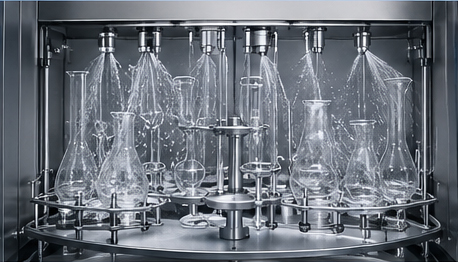
Purpose: To remove large particles and soluble contaminants from the surface of the vessels, preparing them for subsequent deep cleaning.
Use a water stream to rinse away particles, residues, and other substances adhering to the surface of the vessels. No detergents are added during this step. Removing visible impurities from the vessel surfaces allows the cleaning solution in the subsequent main wash stage to come into more thorough contact with the vessel surfaces. At the same time, the pre-wash prevents excessive organic matter from entering the main wash solution, thereby extending the service life of the cleaning solution.
- After the pre-wash drainage, any residual water in the wash chamber is drained to prevent it from mixing with and diluting the cleaning solution used in the next stage.
- Some high-end models perform 1 to 2 fill-and-drain cycles during the pre-wash stage to enhance the rinsing effect.
II. Main Wash Stage
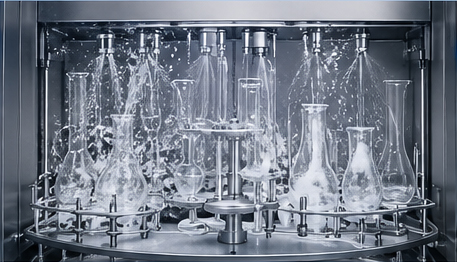
Purpose: To remove organic contaminants (fats, proteins, sugars, etc.) and inorganic salt residues from the surface of the dishes through the chemical action of an alkaline cleaning solution and the physical scouring action of high-pressure water jets.
The main wash stage is the most effective step in the entire cleaning process in terms of stain removal, and its cleaning effectiveness stems from three factors:
1. Saponification and Emulsification/Dispersion
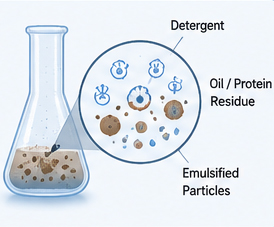
The main components of alkaline cleaning solutions include sodium hydroxide or potassium hydroxide (alkali agents), surfactants, and chelating agents. When the cleaning solution is heated to 50°C or higher:
- Saponification: The alkaline components react with animal and vegetable fats and oils to produce water-soluble fatty acid salts and glycerol. This chemically breaks down the layer of grease adhering to the surface of the tableware.
- Emulsification and Dispersion: Surfactants emulsify the broken-down fats and organic residues into microscopic particles, dispersing them in water and preventing them from redepositing on the surface of the laboratoryware.
- Complexation and Solubilization: Complexing agents in the cleaning solution (such as EDTA) form stable, soluble complexes with metal ions (Ca²⁺, Mg²⁺, Fe³⁺), thereby stripping inorganic salt residues from the surface of the laboratoryware.
2. High-Pressure Spray Rinsing
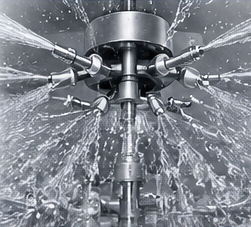
A recirculation pump pressurizes the cleaning solution, creating high-pressure water jets through rotating spray arms at the top and bottom. This provides 360° coverage for rinsing both the interior and exterior of the vessels. For slender vessels such as test tubes, pipettes, and sample vials, a specialized cleaning spindle can be inserted into the vessel to achieve thorough rinsing of the inner walls—a level of cleanliness that cannot be achieved by manual washing.
3. High-Temperature Accelerated Cleaning
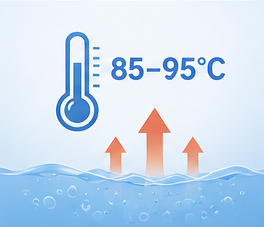
As the water temperature rises, the cleaning solution’s degreasing effectiveness increases. Combined with an alkaline cleaning solution, this achieves a removal rate of over 99% for protein-based contaminants.
The dosage of the alkaline cleaning solution is precisely controlled by a peristaltic pump, preventing waste or inadequate cleaning.
After the main wash cycle is complete, the machine automatically drains the contaminated cleaning solution.
III. Neutralization Stage (Acidic Wash)
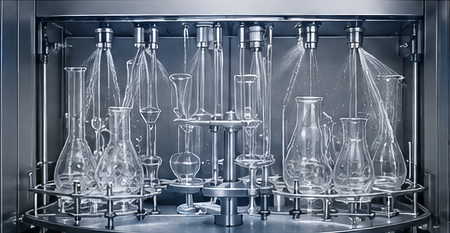
Purpose: To neutralize the alkaline cleaning solution remaining from the main wash stage, remove inorganic mineral deposits, and adjust the pH of the vessel surface to neutral. During the neutralization stage, an acidic neutralizing solution is injected to react with residual alkaline substances on the surface of the glassware. After this stage, the pH is adjusted to a neutral range of 6 to 8. At the same time, the acidic environment effectively dissolves inorganic deposits such as scale (calcium carbonate) and rust. This further removes inorganic contaminants that were not completely eliminated during the main wash stage.
Hazards of Inorganic Contaminants:
The alkaline cleaning solution used in the main wash stage is strongly alkaline; if the vessels proceed directly to the rinse stage, alkaline residues may adhere to their surfaces.
Prolonged exposure of glassware to alkaline residues may cause surface corrosion, affecting the vessels’ lifespan and light transmittance.
Alkaline residues can disrupt the pH environment of subsequent experiments, particularly in pH-sensitive biochemical analyses and cell culture experiments.
Advantages:
1. Dual peristaltic pump design
Some Scitek models feature two independent peristaltic pumps that control the addition of the cleaning solution and the neutralizing solution, respectively. The liquids come into contact only with the inner walls of the tubing, thereby preventing corrosion and cross-contamination.
IV. Rinsing Stage
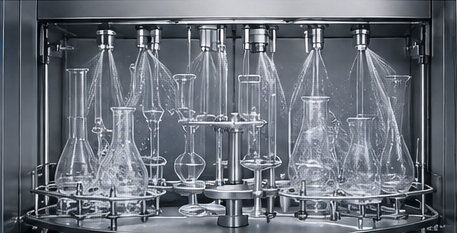
Objective: Thoroughly remove any residual cleaning agent, neutralizing solution, and dislodged contaminants from the surface of the vessels to ensure they meet analytical-grade cleanliness standards.
The rinsing stage uses high-purity water. Through multiple cycles of filling, spraying, and draining, chemical residues adhering to the vessel surfaces are diluted and flushed away. The effectiveness of the rinsing process depends on three factors:
1. Number of rinses
Most standard cleaning procedures specify 2 to 3 rinses. The first rinse removes most of the residual cleaning solution and neutralizing solution. The second and third rinses reduce the residual concentration to negligible levels. For vessels used in trace analysis, the number of rinses may be increased to 4 to 5.
2. Water temperature
High-temperature rinsing (60–75°C) offers two advantages over room-temperature rinsing: hot water has a greater ability to dissolve residues and the elevated surface temperature of the vessels at high temperatures promotes rapid evaporation during the subsequent drying stage.
3. Online Conductivity Monitoring
Some high-end models are equipped with an online conductivity monitoring system during the rinsing stage, which measures the conductivity of the rinse water in real time. When the conductivity drops below a preset threshold, indicating that the rinsing is complete, the system automatically proceeds to the next stage. If the conductivity does not meet the standard, the system automatically adds an additional rinse cycle. This closed-loop control mechanism ensures consistent rinsing performance while preventing water waste caused by unnecessarily prolonged rinsing.
Water consumption during the rinsing phase accounts for 50% to 60% of the total water consumption per wash cycle, making it a key factor affecting operating costs.
After rinsing, the surface of theware should be free of residue, water droplets, and visible water marks.
V. Disinfection and Drying (Optional)

Purpose: To perform high-temperature thermal disinfection of the instruments and remove moisture from their surfaces through hot-air circulation, making them “ready to use immediately upon removal.”
Disinfection
During the disinfection phase, pure water in the washing chamber is heated to 93°C and held at that temperature for a sufficient duration to thermally inactivate microorganisms through high heat. 93°C is the highest temperature that can be safely controlled below the boiling point of water at atmospheric pressure. Maintaining this temperature for at least 5 minutes denatures the proteins of microorganisms such as bacterial vegetative cells, fungal spores, and viruses, achieving a moderate level of thermal disinfection.
In addition, a separate sterilizer can be used to sterilize the vessels.
Drying
The drying stage employs hot-air circulation drying, in which air is heated to 70–90°C, causing moisture on the surface of the vessels to evaporate.
The drying stage uses a hot-air circulation drying method: heating elements heat the air to 70–90°C. A fan circulates the hot air within the cleaning chamber. Moisture on the surface of the vessels evaporates due to the heat, and the water vapor is exhausted from the chamber via the exhaust system.
Hot-air circulation drying offers the following advantages over natural air-drying:
Time control: Natural air-drying typically takes several hours or even overnight, whereas hot-air drying can be completed in 10–30 minutes.
Prevention of secondary contamination: Drying takes place in a sealed chamber, preventing the vessels from being exposed to dust and microorganisms in the open air.
No water marks left behind: High-temperature hot air causes moisture to evaporate rapidly, leaving no water marks on the surface of the vessels, which can then be used directly for experiments.
The Importance of HEPA Filtration:
The hot air entering the drying stage undergoes three levels of filtration—pre-filter, medium-efficiency filter, and HEPA filter—to ensure that the air delivered into the chamber is free of particulates and microorganisms. This is particularly critical for microbiology laboratories and environments with high cleanliness requirements.
Several Key Factors Affecting Cleaning Performance
1. Selection and Concentration of Cleaning Solutions
The quality of alkaline cleaning solutions and acidic neutralizing solutions directly affects cleaning performance. The concentration of cleaning solutions should be adjusted based on the type and severity of contaminants. Grease-based contaminants require higher alkaline concentrations and temperatures, while protein-based contaminants are more sensitive to temperature and processing time.
2. Loading Method for Racks and Ware
The way ware is loaded directly affects cleaning effectiveness. Correct loading requirements:
Place ware with the openings facing downward to facilitate water inflow and outflow.
Slender vessels (pipettes, test tubes) should be inserted into dedicated washing columns to ensure the inner walls are thoroughly rinsed.
Leave sufficient space between vessels to prevent them from blocking the spray water flow.
Vessels made of different materials (glass vs. plastic) should be washed in separate batches to avoid conflicts in temperature parameters.
3. Water Quality
The water quality used during the rinsing stage directly affects the final cleanliness of the vessels. The conductivity of pure water should be controlled at ≤ 2 μS/cm (reverse osmosis water) or lower (deionized water). If tap water is used for rinsing, minerals in the water will form water spots on the vessel surfaces, affecting subsequent analytical results; in particular, this may introduce positive biases in trace metal analysis.
4. Matching Program Parameters to Contaminants
Different types of contaminants require different combinations of cleaning parameters:
- Grease-based contaminants: Require higher temperatures (70–75°C) and longer main wash times, with the concentration of the alkaline cleaning solution appropriately increased.
- Protein-based contaminants: Temperatures should not be too high (60–65°C) to prevent protein denaturation and coagulation, which makes them more difficult to remove.
- Inorganic salts/scale: A stronger acidic neutralization stage is required; the neutralization time may be appropriately extended.
- Sugar residues: Since sugars are prone to caramelization at high temperatures, the pre-wash stage should involve thorough rinsing at room temperature before proceeding to the high-temperature main wash.
Conclusion
The cleaning process of a fully automatic bottle washer is not simply a matter of “rinsing, heating, and drying,” but rather a precisely engineered, multi-stage, coordinated process. The temperature, duration, medium, and amount of chemicals added in each stage can be independently programmed and controlled. This enables a single bottle washer to accommodate varying cleanliness requirements, ranging from standard glassware to trace analysis vessels.


Get Social